
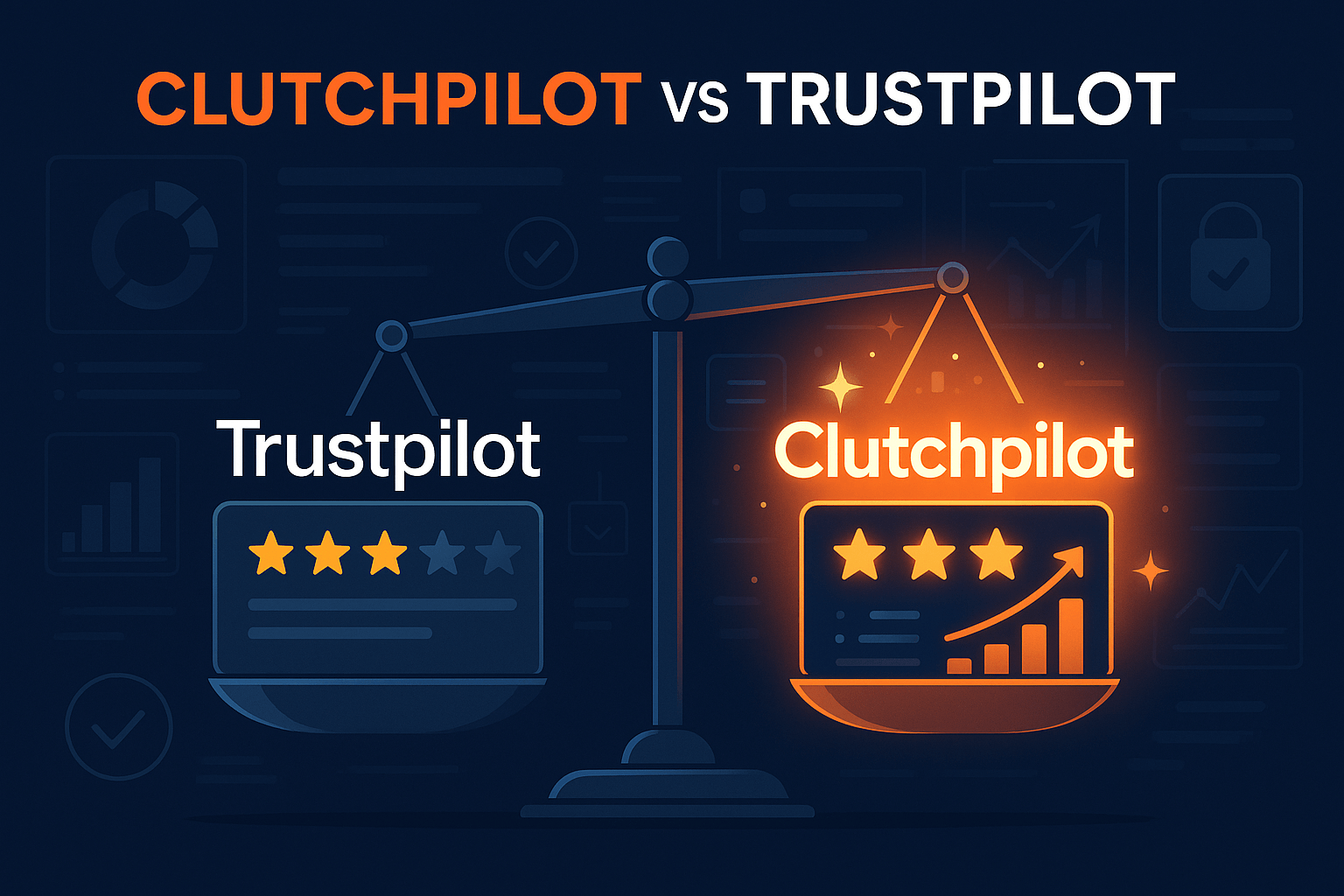
Review platforms look alike from the outside, but they differ in who can post, what businesses pay for and what happens when a review is disputed. This review looks at Clutchpilot, a business directory and review platform, using what its own public pages say. It then sets the platform beside Trustpilot and Yelp by criteria rather than verdicts, and finishes with a checklist you can use on any review site.
What Clutchpilot Is
According to its about page, Clutchpilot is a "free business directory and review platform" that aims to help people find businesses they can trust. Anyone can browse the directory by name, category or location without an account. Listing pages can be filtered by country, rating, verification status and category, and sorted by newest, oldest or most viewed.
The site also describes tools for signed-in users: an AI chatbot for recommendations, a matching feature where you describe a project and receive between one and five suggested providers, shortlists, on-site messaging and quote requests. These require signing in with a Google or LinkedIn account.
What It Offers Businesses
A basic profile listing is free, according to its FAQ and about page. The FAQ also mentions optional provider features: enhanced profiles, advanced analytics, targeted advertising and marketing tools, with ads described as giving priority placement on relevant service pages. The pages checked for this article do not publish prices for these.
Reviews follow a set format. The FAQ says clients can leave a review through an online form for free, or through a verified phone interview that is available to paid accounts. Providers can also submit clients as references from their account. Each review is organized into five parts: Background, Challenge, Solution, Results and Client Feedback. That layout reads naturally for project-based work, such as a website build or a renovation, and less naturally for a single coffee or a haircut.
Who It May Suit
Whether any platform helps depends mostly on whether your customers look there. Going by what the site describes, it may be worth a look if:
- You sell project-based services, such as an agency, consultancy, trade or studio, and your clients can describe a challenge and a result.
- You want a free extra listing next to your Google and social profiles without committing budget.
- You are a buyer comparing providers and want filters for budget, hourly rate and company size.
It may be a weaker fit if most of your customers find you through Google Maps, Yelp or word of mouth in a small local area. In that case your time usually goes further on the profiles those customers already read.
Strengths
- A free entry point: a listing costs nothing, and buyers can browse without an account.
- A stated stance on bought reviews: the about page says reviews come from real people and that the platform does not sell review placements, and its terms ban false, misleading or defamatory reviews.
- Public replies: the business terms let a business respond publicly to reviews.
- No removal on request: the business terms say negative reviews are not removed on request unless they breach its review policy. Trustpilot states a similar principle.
- Structured reviews: the five-part format gives readers more context than a star rating alone.
Limits and What to Check Before You Use It
These are not complaints about one site. They are the questions to ask before you rely on any profile.
- How verification works: the pages call reviews "verified" and mention verified phone interviews, but the pages checked do not explain the checks. Ask what the label means before you quote it to customers.
- Disputes: the terms allow the platform to moderate or remove content that breaks its policies, but they do not describe a dispute or appeal process. Find out how you would contest a review you believe is fake.
- Paid options and ranking: the about page says no premium tier is needed to be discovered, while the business terms list participation in premium plans, where applicable, as one ranking factor next to the number and quality of reviews. Ask how paid features affect your position before you pay.
- Price and refunds: prices for optional upgrades are not published on the pages checked, and the business terms say fees are non-refundable unless otherwise stated.
- Reach: the pages checked do not give total review or visitor counts. Search for your own category, see which platforms appear in the results and judge whether your customers will see this one.
- Thin ratings: a 4.8 built on three reviews says less than a 4.3 built on thirty. That is true everywhere, so look at the count and the dates, not only the score.
Clutchpilot, Trustpilot and Yelp by Criteria
The table below lists what each platform's own pages say. It is a set of criteria, not a ranking, and the criteria that matter depend on your business. Policies and prices change, so confirm them on each site before you decide.
| Criterion | Clutchpilot | Trustpilot | Yelp |
|---|---|---|---|
| Main focus | Free business directory and review platform | Consumer review platform with company profiles | Local business pages and reviews |
| Free profile | Yes, a free listing | Yes, a free plan | Yes, a free business page |
| Paid options | Optional upgrades such as enhanced profiles and advertising; prices not published on the pages checked | Plus, Premium and Enterprise plans, with prices listed for the first two and annual contracts (pricing page) | Yelp Ads and Page Upgrades; prices not shown on its business page |
| Asking for reviews | Online form, or a verified phone interview on paid accounts; providers can submit client references | Review invitations, which must go to customers in the same way, not only the happy ones (guidelines) | Advises businesses not to ask customers for reviews (Yelp's explanation) |
| Replying to reviews | Public responses allowed in the business terms | Businesses can reply and are asked to be professional | The free page includes responding to reviews |
| Suspect or unwanted reviews | May moderate or remove content that breaks its policies; no dispute process described in the terms | Businesses can flag reviews that breach the guidelines; disliking a review is not a valid reason | Automated software decides which reviews are recommended; others stay viewable but do not count toward the star rating |
| Review format | Five parts, from Background to Client Feedback | Star rating and written review | Star rating and written review |
Fake Reviews Are an Industry-Wide Problem
No platform is free of them, so skepticism applies everywhere. Journalists and consumer groups have documented fake reviews on several sites. In a Which? investigation from July 2022, researchers bought fake five-star reviews for an invented business on Facebook, Google and Trustpilot. On Trustpilot the invented business had 19 five-star reviews and a 4.6 TrustScore within three weeks. Trustpilot said it removed the suspected fake reviews linked to the investigation and sent a cease and desist letter to the seller.
The lesson is not to avoid one site. It is to read reviews critically wherever you find them, and to check how a platform detects and handles suspicious ones.
How to Evaluate Any Review Platform
- Who can post, and how are they checked? Look for a written explanation of verification, not only a badge.
- What happens to a review you dispute? A sound policy lets you flag reviews that break the rules and does not remove them just because a business dislikes them. Trustpilot's guidelines, for example, say businesses have no control over review removal, whether or not they pay.
- Do paid features touch ranking or display? Ask directly, and get the answer in writing if money is involved.
- What are the rules on asking for reviews? They differ. Google prohibits incentives for reviews, Trustpilot bans incentivized reviews and selective invitations, and Yelp advises against asking at all. Learn the rules before you send a single request.
- Can you reply in public? A visible reply is often your only chance to show how you handle problems.
- Do your customers use it? Search your business name and category the way a customer would, and see which review sites appear.
- What are the contract and exit terms? Some paid plans run for a year at a time. Check cancellation and refund terms before you sign.
Using More Than One Platform
Most small businesses do not need to choose just one. A common order is to start with Google Business Profile, because Google says more reviews and positive ratings can help local ranking, then add the platforms where your own customers look. Our guide to Google Business Profile optimization covers that first step, and the comparison of alternatives to Trustpilot lists other options. For the wider picture, see how businesses grow with review platforms and how to build trust online with reviews.
The Bottom Line
Clutchpilot is a free directory and review platform with a structured review format and optional paid features. Its public pages leave some questions open, mainly about verification, disputes and how paid options affect ranking. Trustpilot and Yelp have trade-offs of their own, from annual plans to automated filtering. The right choice is the platform where your customers actually look and whose rules you are comfortable with. Try any of them on the free tier first, read the terms, and check back after a few months to see whether it brings real enquiries.
Frequently Asked Questions
No Tags
Comments (0)