

If you have been around SEO for a while, you probably remember the old directory era. People submitted their site to hundreds of listing pages, hoped for a few links, and watched rankings jump. Then Google cracked down, and directories picked up a reputation for being spammy and outdated. So it is fair to ask whether they are worth any effort today.
The honest answer is yes, but not in the way they used to work. Business directories still matter for SEO because they help Google confirm who you are, where you are, and whether customers trust you. They are far less useful as a shortcut for building links. Knowing the difference saves you time and keeps you out of trouble.
This guide explains what directories actually do for your rankings, which ones are still worth your time, which habits to avoid, and how to build listings that work. If you are also working on your overall local visibility, our guide to local SEO for small businesses covers the bigger picture.
Key Takeaways
- Directories still matter for local SEO, brand trust, and visibility in AI search.
- They are not a reliable way to build links, and low quality directories can look like spam.
- Consistent name, address, and phone details across listings matter more than the number of listings.
- A small set of the right directories beats hundreds of random ones.
- Reviews and complete profiles are what make a listing useful to customers and search engines.
The Short Answer: Yes, but Not the Old Way
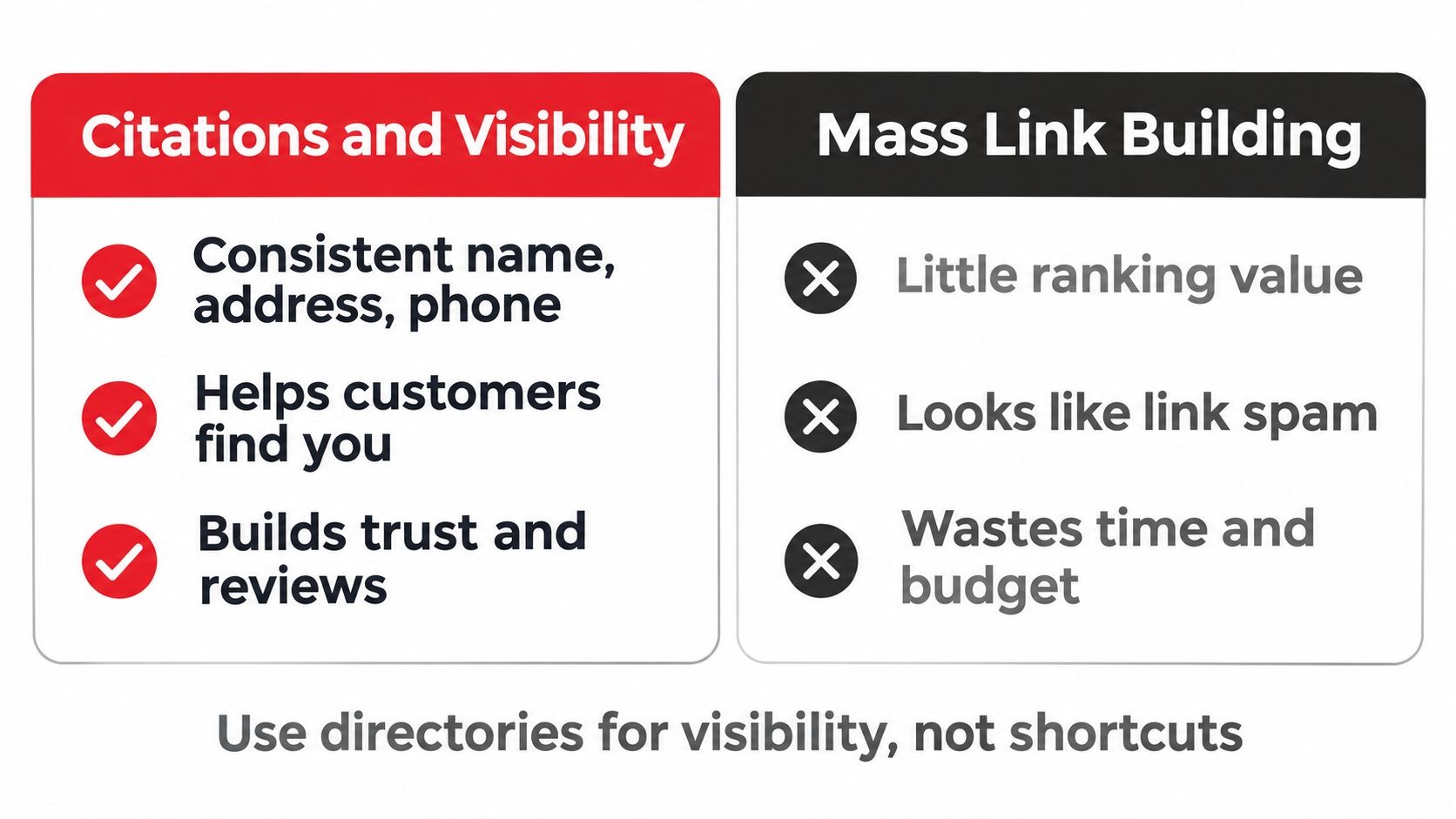
Business directories still matter, but their job has changed. It helps to separate two very different uses.
The first use is citations and visibility. A citation is any mention of your business name, address, and phone number on another site. Directories are one of the main places those mentions live. When your details match across the web, search engines trust them more, and customers can find you in more places. This use is valuable and still recommended.
The second use is link building. In the past, a directory link could give a site a quick ranking boost. Today, Google treats most low quality directory links as having little value, and large scale submissions can be seen as an attempt to manipulate rankings. This use is weak, and it carries risk.
Think of it like a phone book that also lives inside maps, apps, and review sites. Nobody opens a phone book to boost a website's rankings, but plenty of people use listings to decide who to call. A directory that helps customers choose you also tends to help search engines understand you, and that overlap is where the real value sits.
So the practical answer is to treat directories as part of your local presence and your reputation, not as a link tactic. Later in this guide, you will see exactly which directories fall into each group.
What Are Business Directories?
A business directory is a website that lists businesses with details like their name, address, phone number, website, hours, category, and often reviews. Some are huge and general. Others focus on one city, one industry, or one type of customer.
General and Local Directories
These are broad listing sites where almost any business can appear. Think of platforms that organize businesses by category and city, such as Yelp, Yellow Pages style sites, and regional business guides. They bring in a lot of searches from people looking for services nearby, and they are often used by data providers that feed other sites and apps.
Industry and Niche Directories
These focus on one field, such as legal, medical, home services, or software. A lawyer might be listed on a legal directory, and a roofer on a home services site. Customers who visit these sites are already looking for your type of service, so the traffic is often more valuable even if it is smaller.
Map and Platform Listings
Some of the most important listings are not called directories at all. Google Business Profile, Bing Places, Apple Business, and Facebook business pages are structured listings that appear inside maps, search, and apps. For local businesses, these usually matter most, which is why we wrote a full guide on how to optimize your Google Business Profile.
Review and Reputation Platforms
Review platforms act like directories with feedback attached. Customers use them to compare options and decide who to trust. Clutchpilot is one example. It is a business directory where companies are listed with ratings, review counts, categories, and verification status, so people can research providers before they contact them. These platforms help with both visibility and trust, which is why they belong in a modern listing strategy.
How Directories Help SEO Today
Citations and NAP Consistency
NAP stands for name, address, and phone number. When these details are the same everywhere your business appears, it becomes easier for search engines to match all those mentions to one real business. When they differ, such as an old phone number on one site or "Street" in one place and "St." in another, it creates doubt.
Directories are one of the easiest ways to keep this data consistent, because most businesses have a handful of core listings that rarely change. A clean set of accurate listings supports your Google profile and your website, and it reduces the chance of customers finding wrong information.
Here is a simple example. Imagine a dental clinic that moved two years ago. Its Google profile shows the new address, but an old directory still lists the previous one, and a third site shows a different phone number. A patient who finds the old listing drives to the wrong place and leaves a frustrated review. Search engines see the conflict too, and they have to guess which details are correct. Fixing those listings takes an hour and removes both problems.
Local Pack Prominence
When Google decides which businesses to show in the local results, it looks at relevance, distance, and prominence. Google explains these in its help page on how it ranks local results. Prominence includes how well known your business seems, and that is shaped by information Google finds across the web, including listings, articles, and reviews.
A strong presence on trusted directories adds to that picture. It will not outrank a poor website on its own, but it can help close the gap between you and a competitor who has been online longer.
Links, Nofollow, and Referral Traffic
Many directory links are marked nofollow or are otherwise treated with low weight, so you should not expect them to move rankings the way a good editorial link would. Still, they are not useless. A listing on a respected industry directory can send real visitors to your site, and those visitors often have buying intent.
Referral visits also teach you something. If a niche directory sends a handful of visitors who call or fill in your form, it is doing more for your business than a high scoring directory that sends nobody. Over time, those visitors can also search for your brand by name, which is another positive signal.
A good way to think about it is this. Do not judge a directory by the link alone. Judge it by whether a real customer might use it to find you.
Brand Mentions and Entity Trust
Search engines try to understand businesses as entities, which means a real organization with a name, location, services, and reputation. The more reliable places that describe your business in the same way, the clearer that entity becomes. Directories, review platforms, and profiles all contribute to this clarity, even when they pass little link value.
Where Directories Do Not Help
Mass Submissions and "Directory Hack" Claims
You may see offers to submit your site to hundreds or thousands of directories for a small fee. These services usually rely on low quality sites that nobody visits. They add clutter, create inconsistent data, and offer almost no benefit. If a pitch promises fast rankings from bulk submissions, treat it as a warning sign.
Chasing Domain Authority
Some marketers pick directories based on a high Domain Authority score. That number comes from third party tools, not from Google, and it says nothing about whether real customers use the site. A directory with a high score but no relevance to your industry can be less useful than a small niche site that your customers trust.
It also helps to know what Google says. Its spam policies list low quality directory or bookmark links as an example of link spam when they are created mainly to manipulate rankings. The key phrase is "mainly to manipulate." A listing meant to help customers find you is different from a link placed only to chase rankings.
Paid Links That Pass PageRank
Paying for a directory listing to get a followed link is risky. Paid placements should be clearly marked and use the right attributes. If a directory sells ranking power instead of visibility, avoid it.
Which Directories Still Matter
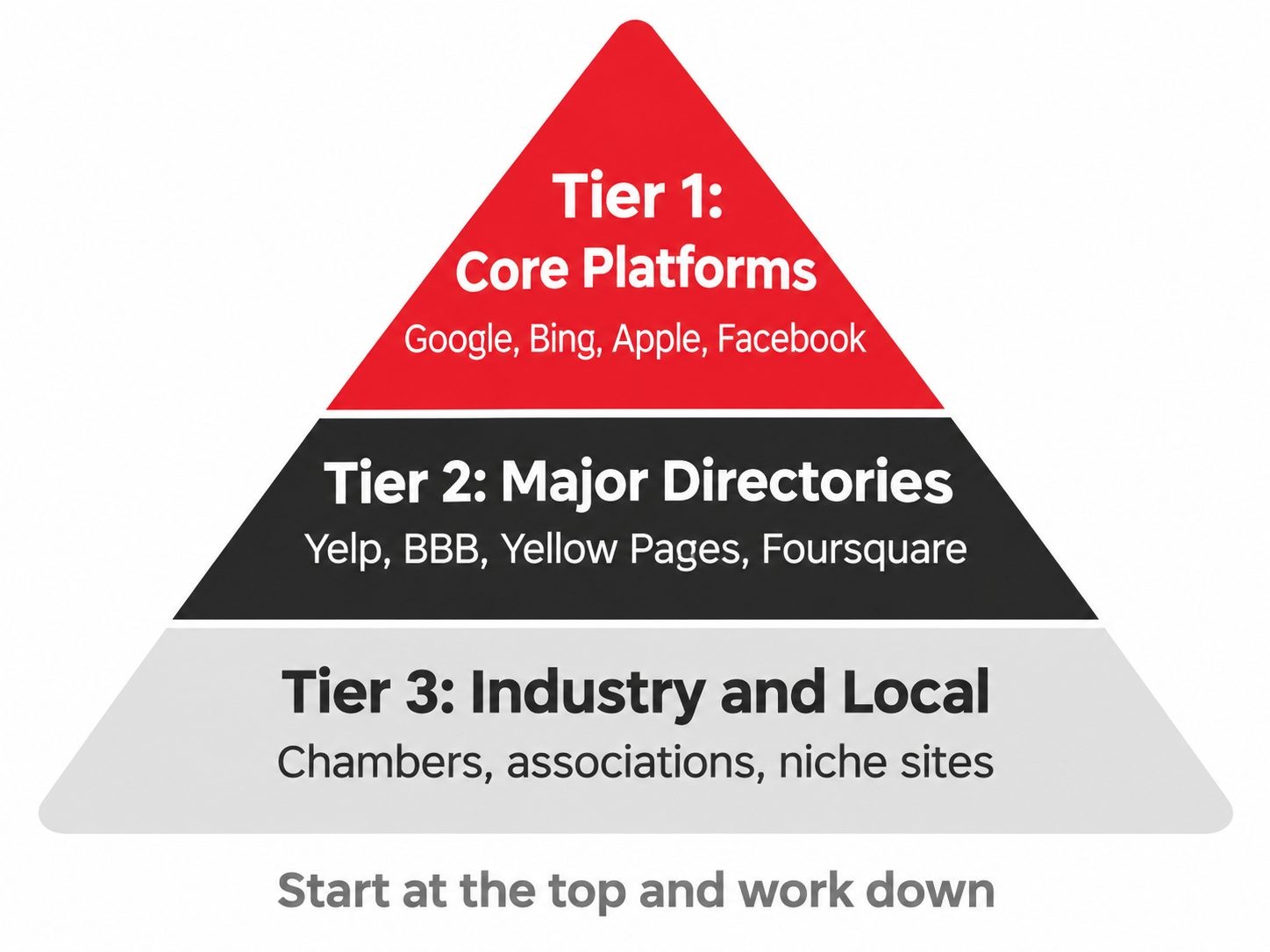
A simple way to prioritize is to group directories into tiers. Start at the top and work down only as far as makes sense for your business.
Tier 1: Core Platforms
These are the listings almost every local business should claim and keep accurate.
- Google Business Profile. The most important local listing for most businesses.
- Bing Places. Powers listings in Bing and some other tools.
- Apple Business. Supports how your business appears in Apple Maps and related apps. You can learn more on the Apple Business site.
- Facebook. Many people still check a business page for hours, photos, and reviews.
Tier 2: Major Directories
These large platforms have strong brand recognition and attract searches from customers.
- Yelp, for restaurants, home services, and other local businesses.
- Better Business Bureau, for trust and complaint history.
- Yellow Pages style sites, for general local searches.
- Foursquare, which feeds data into other apps.
- Nextdoor, for neighborhood based recommendations.
You do not need every one of these. Pick the ones where your competitors appear and where your customers actually look. Our list of top business directory sites goes deeper on the options.
Tier 3: Industry and Local Directories
Niche listings often bring better leads. Examples include chambers of commerce, professional associations, local business guides, and trade directories for your specific field. A contractor might list with a home improvement association, while an accountant might join a professional body directory.
For example, a family law firm might appear on a state bar directory, a local business journal list, and a legal advice site. A bakery might join a city food guide and the local chamber of commerce. These listings tell search engines and customers that you belong to a real community and a real industry.
These listings can also be easier to get approved on and may offer valuable local context. Ask yourself whether a customer in your market would trust and use the site.
Review and Trust Platforms
Customers often read reviews before they choose a provider, so review focused directories deserve a place in your plan. Add a complete profile on Clutchpilot and other relevant platforms, collect real customer feedback, and respond to it. We also cover why trust matters in more detail in our post on how directories build trust and our guide on how to build trust with reviews.
Directories and AI Search
More people now ask AI tools questions like "Who is a good electrician near me?" or "What is the best accounting software for a small team?" These tools pull from many sources, and business listings and reviews are among the places they can find structured information about companies.
This area is still changing, so it is wise to avoid big promises. But the basics are clear. Complete, consistent, and accurate listings make it easier for any system, human or automated, to understand what your business does and where it operates. Clear descriptions, correct categories, and strong review profiles all help.
A few practical steps support this. Use the same business name and description style across platforms. Make sure your website states the same details. Add structured data to your site where appropriate. And keep your profiles updated so old information does not confuse AI tools or customers.
If you want to see how this works in practice, search for a service in your own city and note which directories appear on the first page. Those sites already have visibility for the searches your customers use, so a complete listing there can put your business in front of people who are ready to choose. Do the same for your top competitors, and you will quickly see which platforms are worth claiming and which you can ignore.
How to Choose a Directory
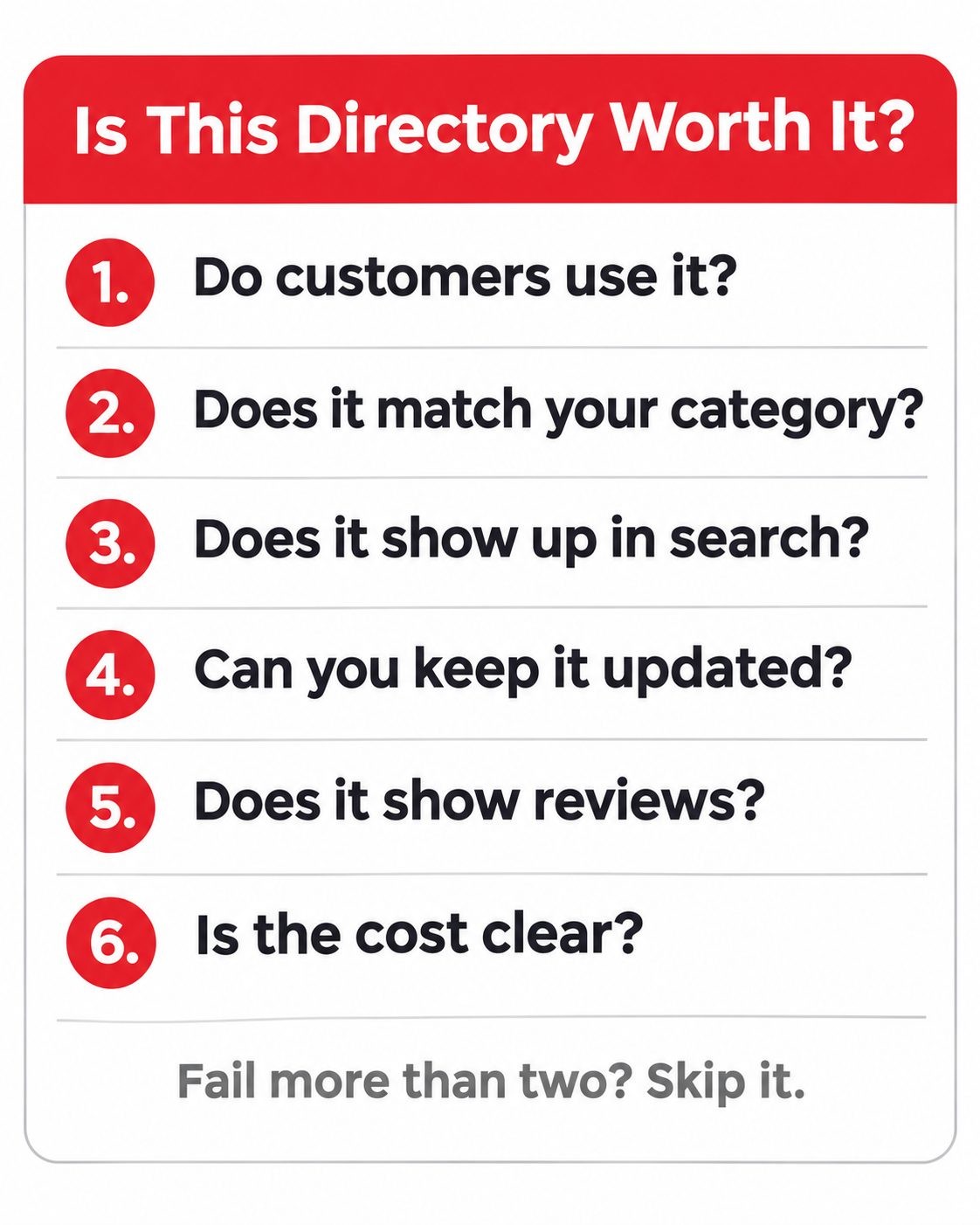
Before you spend time on any directory, run it through this checklist.
- Do your customers use it? Look for signs that real people search there, such as reviews, activity, and recent updates.
- Does it match your category? The more relevant the site is to your industry or area, the better.
- Does it appear in search results? Search for your service and city and see whether the directory shows up.
- Can you keep it updated? Every listing becomes a task. Do not claim more than you can maintain.
- Does it show reviews or trust signals? These help customers decide.
- Is the cost clear? If it is paid, you should be able to explain what return you expect.
If a directory fails more than two of these, skip it. Fewer, better listings are easier to manage and more useful.
How to Build a Strong Directory Listing
Create a Master NAP Document
Start with a simple file that holds your exact business name, address, phone number, website, hours, categories, and description. Copy from it every time you create or update a listing. This single habit prevents most consistency problems.
Choose the Closest Category
Pick the category that best describes your main service. If the directory allows more than one, add secondary categories only if they are real parts of your business. Avoid adding unrelated categories to appear in more searches.
Write for the Customer
Use a short, clear description that explains who you serve, what you offer, and what makes you different. Avoid keyword stuffing and repeated phrases. A listing should read like something a person would want to read.
Add Photos and Useful Links
Upload a logo, photos of your location or work, and a link to the most relevant page on your website. A local business can link to its homepage or a location page. A service company might link to a service page that matches the directory category.
Keep the Message Consistent
Your listing should sound like your website. If your homepage says you are a family owned heating company serving one county, your listing should say the same thing in a shorter form. Matching your message builds trust for customers who move between platforms, and it helps search engines connect every mention to one business.
Collect and Answer Reviews
Where the platform allows it, invite satisfied customers to leave reviews and reply to what they write. Do not offer rewards in exchange for reviews, and never post fake ones. Authentic feedback is one of the strongest trust signals you can build.
Free vs Paid Directories
Most important listings are free, including Google, Bing, Apple, and many review sites. Paid options may offer extras such as featured placement, lead forms, or analytics.
Before paying, ask three questions. Does the directory attract your exact type of customer? Can you track leads that come from it? And does the price make sense compared with the likely return? If a seller promises guaranteed rankings or a flood of backlinks, walk away. Start with free listings and only pay when you can measure a clear benefit.
How to Audit and Clean Up Your Listings

If you have been in business for a while, you may already have listings you forgot about. A simple audit helps.
- Search your business name, phone number, and address and write down every listing you find.
- Compare each one against your master NAP document.
- Correct wrong details, update old phone numbers, and add missing information.
- Claim unclaimed listings so you control the data.
- Report or merge duplicates so reviews and traffic do not split.
Do this once a year, or whenever you move, change your phone number, or rebrand.
Keep a simple spreadsheet with the directory name, the login email, the date you last checked it, and any notes. When a team member leaves or you change agencies, you will still know where every listing lives and who controls it. Many businesses lose access to old listings because the account was created with someone's personal email, so use a shared business address whenever possible.
If you find a duplicate, do not simply ignore it. Use the platform's tools to merge or remove it, and keep the version with the most reviews and the most accurate information. Leaving duplicates in place splits your reputation across multiple pages and makes your business look disorganized.
Common Directory Mistakes
- Inconsistent NAP details. Small differences across listings create doubt.
- Keyword stuffing the business name. It risks removal and looks spammy.
- Submitting to hundreds of directories. Quantity creates clutter, not value.
- Ignoring reviews. Unanswered feedback hurts trust.
- Leaving profiles half finished. Incomplete listings look abandoned.
- Choosing the wrong category. It sends the wrong signal to customers and search engines.
- Buying links disguised as listings. It can violate guidelines.
- Forgetting duplicates. They split reviews and confuse customers.
How to Measure Results
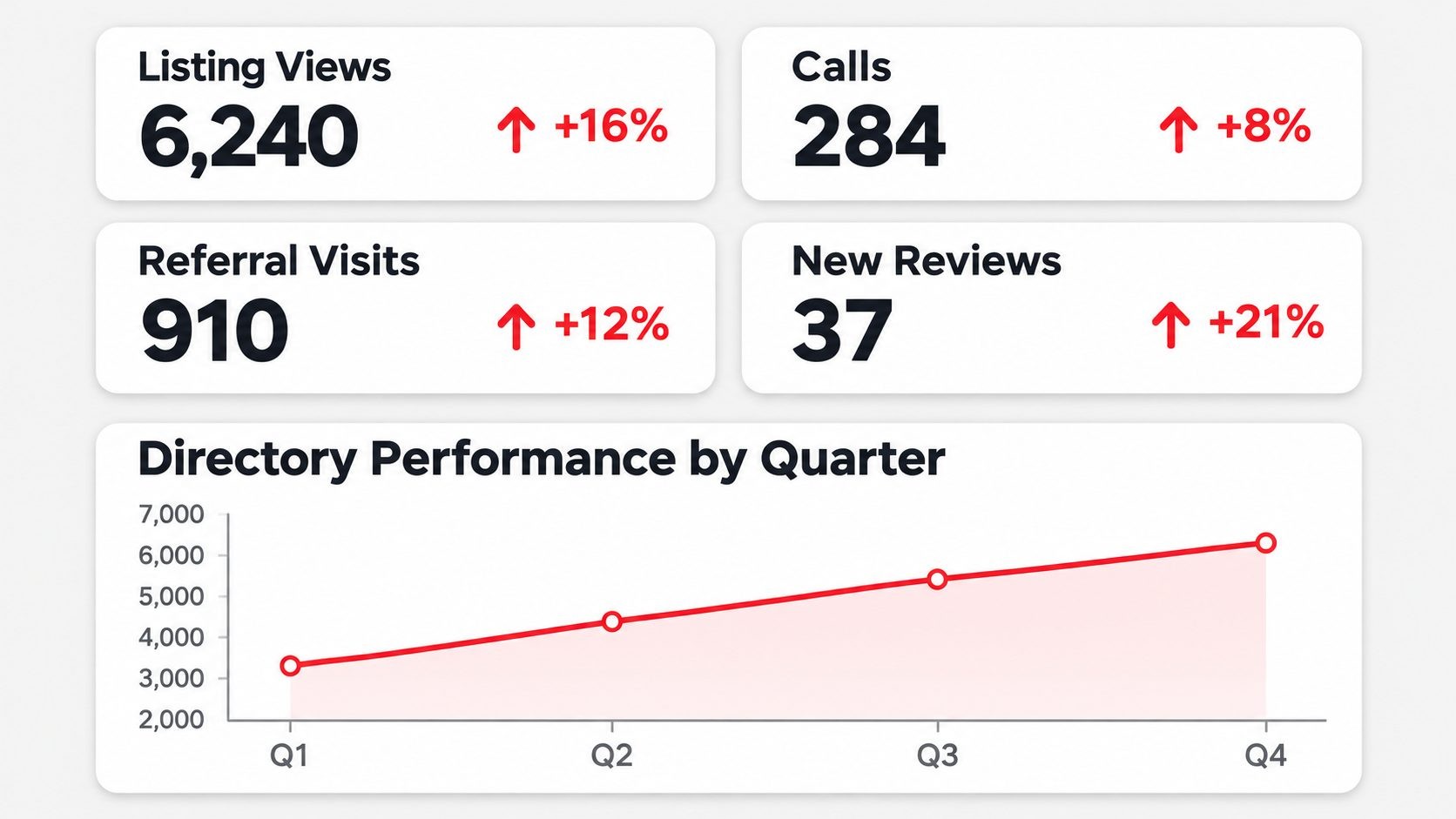
You do not need a complicated setup to see whether directories are working. Look at a few simple signals.
- Listing views and clicks inside each platform's dashboard.
- Calls and direction requests, which show customer intent.
- Referral traffic to your website from directory sites.
- Review count and rating, which show trust growth.
To make traffic easier to see, add UTM parameters to your website link on each listing, such as ?utm_source=yelp&utm_medium=directory. Then check your analytics to see which directories send visitors who stay, read, and contact you. A free tool like SEO Site Checker can also scan the landing page your listings point to and flag issues like missing titles or broken links.
Be patient with the numbers. A new listing may take a few weeks to settle, and seasonal changes can affect results, so compare each quarter with the same period last year when you can. Record what you changed, such as a new category or updated photos, so you can connect improvements to specific actions.
Review the results every quarter. Keep the listings that produce calls or leads, and stop spending time on the ones that do not.
FAQs
Conclusion
Business directories are not the magic ranking tool they once were, but they are far from dead. When you use them to keep your information consistent, earn trust through reviews, and reach customers where they already search, they remain a solid part of local SEO.
Be selective. Start with the core platforms, add a few strong industry and local listings, and keep everything accurate. Then audit them once or twice a year. If you want a simple first step, pick your five most important listings this week and check that every detail matches. That one hour of work can make your business easier to find and easier to trust.
No Tags



Comments (0)