
- Digerati
- Reputation
- <25
- 0
Before most people call a plumber, book a table, or hire an agency, they do one quick thing. They check the reviews. It takes less than a minute, and in that minute they decide whether your business feels safe to choose or safer to skip.
That is why the way online reviews impact a business goes far beyond a star rating. Reviews shape how much customers trust you, how many of them contact you, how easily you show up in search, and how much revenue you keep. A few honest sentences from a stranger can carry more weight than a page of your own marketing.
This guide explains exactly how reviews affect trust, sales, and visibility. You will see what the research says, how negative and fake reviews change the picture, which platforms matter, and how to turn customer feedback into steady growth. If you want a broader look at building credibility, our post on how to build trust online with reviews is a good companion to this one.
Key Takeaways
- Reviews work as social proof, which lowers the risk customers feel when choosing a business.
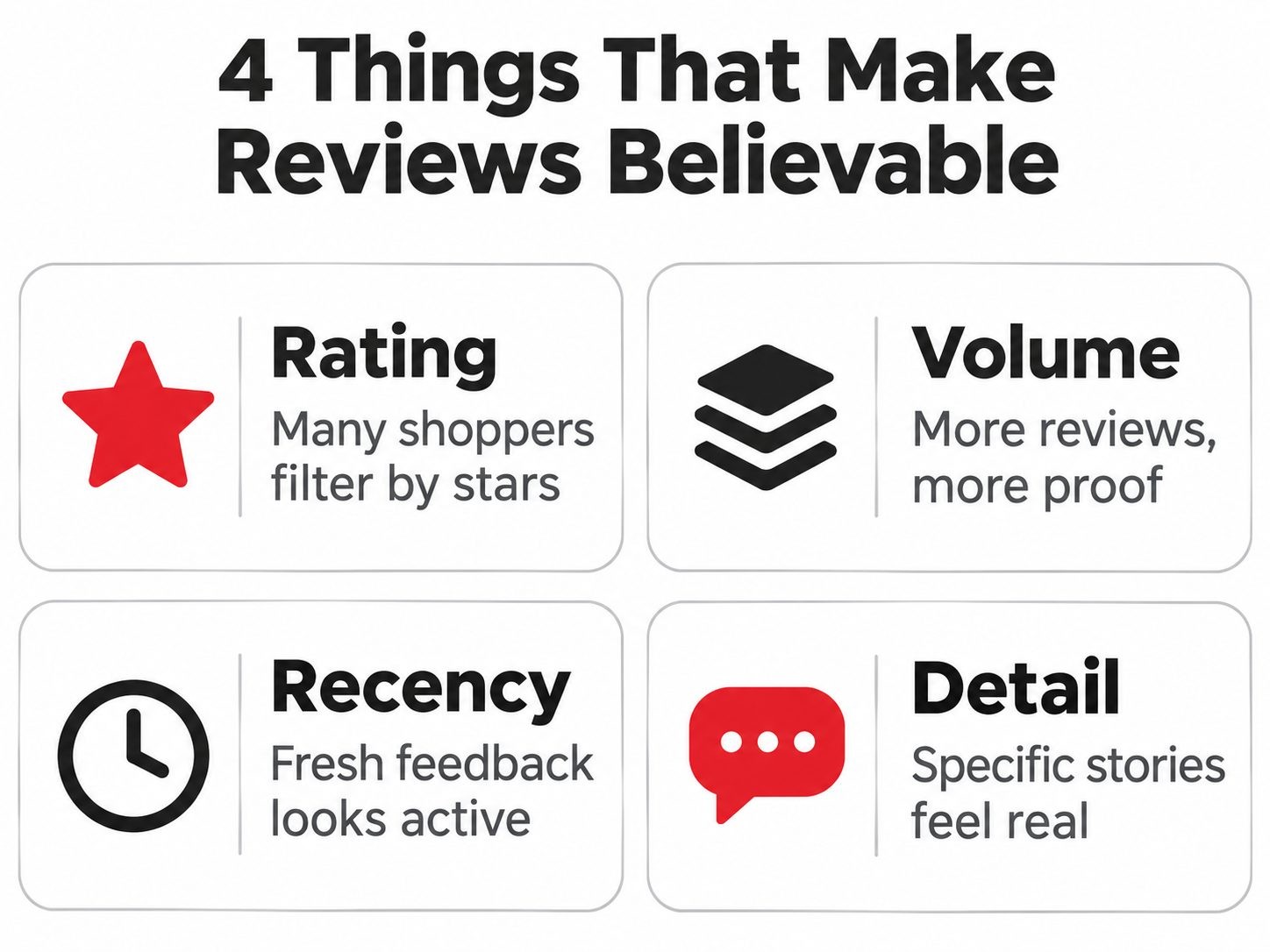
- Rating, volume, recency, and detail all affect how much people trust your reviews.
- Research links higher ratings to higher revenue, and reviews influence local search visibility.
- A few negative reviews are normal. How you respond matters more than the complaint itself.
- Fake reviews are risky and are now targeted by a Federal Trade Commission rule.
The Short Answer: Reviews Lower the Risk of Choosing You
When a customer cannot try something first, they look for proof that other people already did and were happy. Reviews give them that proof. A business with many recent, detailed, positive reviews feels familiar and safe. A business with few or no reviews feels like a gamble.
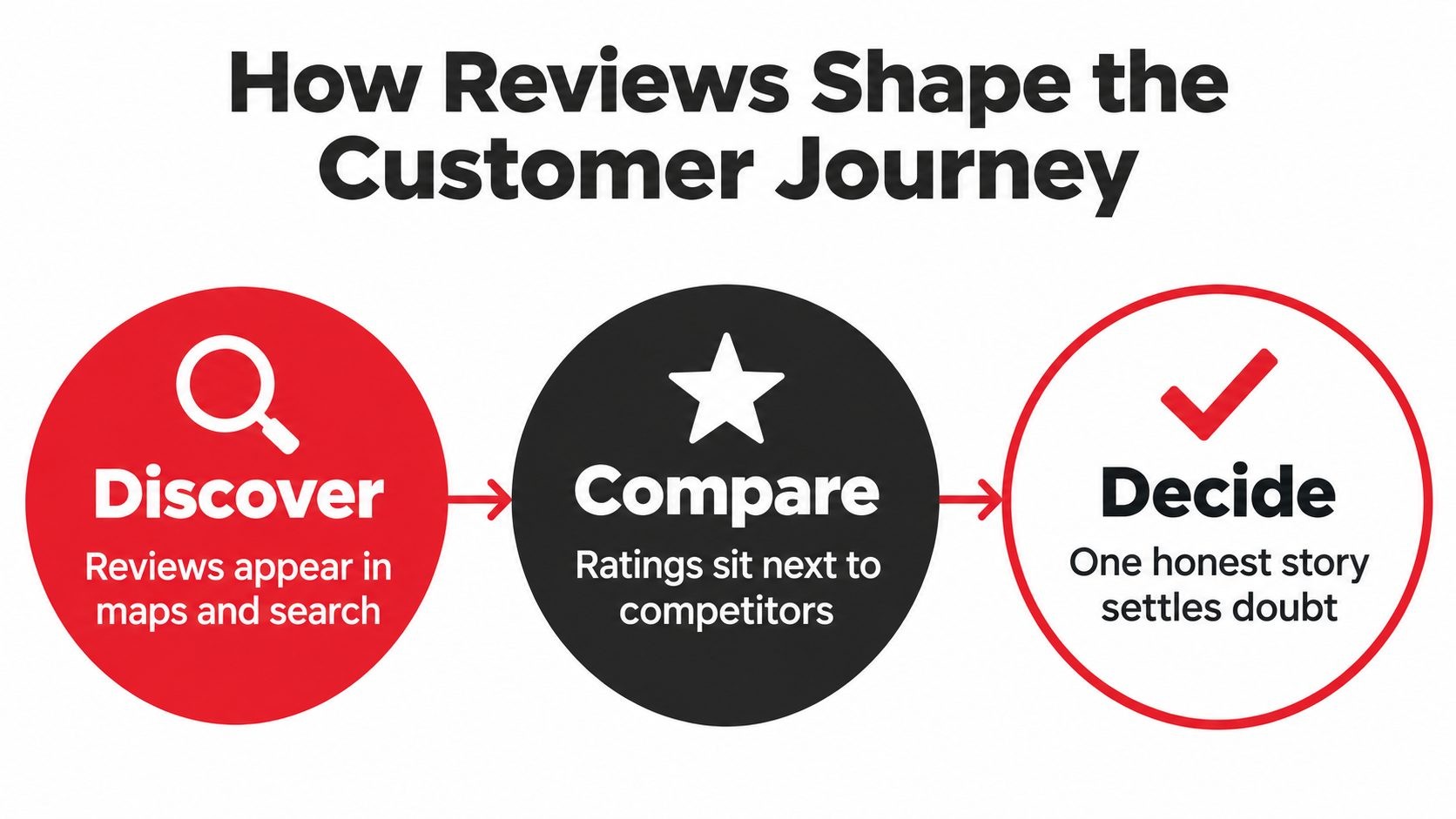
This effect touches every stage of the customer journey. Reviews help people discover you, because they appear in maps and search results. They help people compare you, because ratings sit right next to your competitors. And they help people decide, because a single honest story can settle a last minute doubt.
The data backs up how common this behavior is. BrightLocal's Local Consumer Review Survey for 2026 reports that 97 percent of consumers read online reviews for local businesses, and 41 percent say they always do. In other words, almost every potential customer is looking at your reviews, whether you manage them or not.
How Online Reviews Build (or Break) Customer Trust
Social Proof and Risk Reduction
Social proof means people look to others to decide what is safe. When strangers say a business was honest, on time, and fair, new customers feel less afraid of making a mistake. That lowered risk is the foundation of trust.
Advertising cannot do this job as well, because customers know you wrote your own ads. A review comes from someone with nothing to gain, which is exactly why it feels believable.
Star Ratings and Credibility Thresholds
Star ratings act like a quick filter. Many people will not even click on a business that falls below a certain score. The same BrightLocal survey found that 31 percent of consumers will only use a business rated 4.5 stars or higher, up from 17 percent in 2025.
This does not mean you need a perfect score. In fact, a flawless rating can look suspicious. It does mean that a rating that slips to the low three star range can quietly cost you customers who never tell you why they chose someone else.
Volume and Recency
A high rating based on five reviews is less convincing than a good rating based on two hundred. Volume shows that many people have used and rated you. Recency shows that the business is active and consistent today, not just years ago.
Old reviews can lose their power. A customer who sees nothing but reviews from several years back may wonder whether the service has changed. Steady, fresh feedback keeps your profile looking alive.
Here is a simple way to see this in action. Imagine two electricians in the same town. One has 12 reviews from three years ago, all saying "Good job." The other has 140 reviews, including several from last month, with comments about arriving on time, explaining the work, and cleaning up afterward. Even if their prices are the same, most people will call the second one first. Nothing about the electrical work changed. The proof did.
Detail, Authenticity, and Owner Replies
Specific reviews build more trust than short ones. A line like "They fixed our heater the same day and explained the bill clearly" says far more than "Great service." Customers notice details because they are hard to fake.
Owner replies add another layer. When a business thanks happy customers and handles complaints calmly, readers see a company that listens. Many people read the replies as closely as the reviews.
How Online Reviews Affect Sales and Revenue
Conversion and Purchase Decisions
Reviews influence the exact moment a person decides to act. A strong set of reviews can turn a browser into a caller, a form fill, a booking, or a purchase. A weak or empty profile can send that same person to a competitor in seconds.
Think about how you choose a restaurant in a new city. You probably open a map, look at the top few results, compare ratings, scan a handful of reviews, and pick one. The restaurant that looked most trustworthy won the table before you ever saw the menu.
What the Research Shows
One of the most cited studies on this topic comes from Michael Luca at Harvard Business School. His research, Reviews, Reputation, and Revenue: The Case of Yelp.com, found that a one star increase in a restaurant's Yelp rating is associated with a 5 to 9 percent increase in revenue. The study used Yelp's rating rounding rules to isolate the effect, which makes it a strong piece of evidence.
The study focused on restaurants, so be careful about applying the exact figure to every industry. The broader lesson holds, though. Ratings are not just opinions. They connect to money.
It also helps to remember that many customers never write to you at all. They simply leave. Because of that, the sales impact of reviews is often invisible in your inbox. You will not see the customer who looked at your profile, noticed a rating that felt too low, and chose someone else. You only see the final numbers, which is why tracking calls, bookings, and conversion rates alongside reviews gives a clearer picture.
Higher Intent Leads and Price Confidence
People who read reviews before contacting you tend to arrive more prepared and more convinced. They have already seen proof that you deliver, so they are less likely to haggle over every detail and more likely to ask when you can start.
Strong reviews can also give you room on price. When customers trust that you do good work, they often see cheaper competitors as riskier rather than as a better deal.
Shorter Sales Cycles and Lower Acquisition Costs
Reviews do some of your selling for you. A prospect who reads three detailed customer stories answers many of their own questions before they speak to you. That can shorten the time between first contact and a decision.
It also lowers the cost of winning customers. A review stays on your profile and keeps working long after it is posted, while an ad stops the moment you stop paying. If you are weighing where to spend your budget, it is worth understanding how earned trust compares with paid reach, which is a useful way to think about the choice between organic and paid marketing.
How Online Reviews Affect Local SEO and Visibility
Reviews as a Prominence Signal
Google says local results depend on relevance, distance, and prominence. Prominence reflects how well known and trusted a business seems, and reviews and ratings are part of that picture. You can read Google's own explanation in its guide to improving your local ranking.
Google also states that more high quality reviews and a better rating can help your business rank better in local results. That makes reviews one of the few ranking factors that also directly persuade the customer. To see how reviews fit into a full profile, read our guide on how to optimize your Google Business Profile.
Click-Through and Profile Appeal
Even when two businesses rank next to each other, the one with the stronger rating and more reviews tends to get more attention. Star ratings stand out visually, and customers treat them as a shortcut. A better click rate from the same position can mean more calls, more direction requests, and more website visits.
Reviews also contain words customers use naturally, such as the service they bought and the city they live in. Those phrases make your profile more relevant to the way people actually search.
AI Search and Recommendations
More people now ask AI tools for local recommendations. BrightLocal's 2026 survey reports that use of tools like ChatGPT for local recommendations rose from 6 percent in 2025 to 45 percent in 2026. This area is changing quickly, so treat any single figure with care.
What seems clear is that these tools draw on public information about businesses, and reviews are a large part of it. Detailed, recent, and consistent reviews give any system, human or automated, a clearer picture of what you do well.
How Negative Reviews Affect Your Business
The Real Impact
Negative reviews hurt, especially when they are recent, specific, and unanswered. A one star review that describes a rude employee or a missed appointment can push a hesitant customer toward a competitor. A string of similar complaints can reveal a real problem that deserves attention.
But a single bad review rarely ruins a business. Customers read them in context. They look at your overall rating, how many reviews you have, and how you replied.
How to Respond
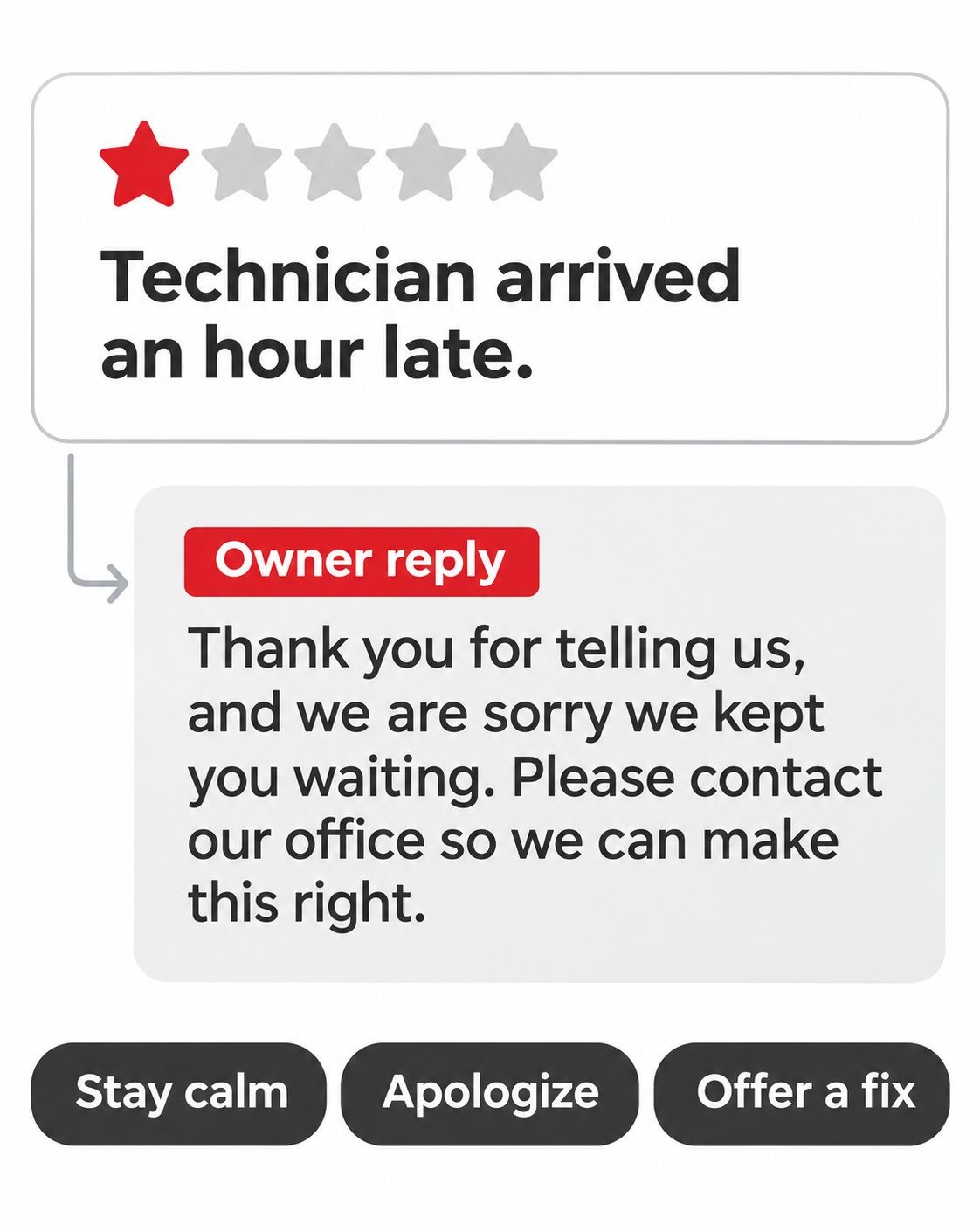
A good reply protects your reputation in front of every future reader. Stay calm, thank the person for the feedback, apologize where it is fair, explain what you will do, and offer to continue the conversation offline. Never argue, blame the customer, or share private details.
Respond quickly if you can. A prompt, professional reply shows you take problems seriously. For a deeper walkthrough, see our guide on how to respond to negative reviews.
Consider a sample reply. If a customer says the technician arrived an hour late, you might write: "Thank you for telling us, and we are sorry we kept you waiting. We have reviewed our scheduling process to prevent this. Please contact our office so we can make this right." It is short, calm, and specific, and it shows every future reader how you treat people when things go wrong.
Why a Few Negative Reviews Can Improve Credibility
A profile with only perfect reviews can look curated or fake. A few critical reviews, handled well, make the positive ones feel more believable. They also show how you behave when something goes wrong, which is often what customers most want to know.
The goal is not to collect bad reviews. It is to avoid panic when they come, and to treat each one as useful information.
Fake Reviews and the FTC Rule
How Fake Reviews Damage Trust
Fake reviews, whether written by you, a competitor, or a paid service, undermine the whole system. Customers are getting better at spotting them, and when they do, they stop trusting not only the fake reviews but the business behind them.
Fake reviews can also trigger removal, penalties, or public embarrassment if they are exposed. The short term boost is rarely worth the damage.
What the FTC Rule Bans
In 2024 the Federal Trade Commission announced a final rule banning fake reviews and testimonials. According to the FTC's announcement, the rule prohibits buying or selling fake or false reviews, including AI generated ones, and bars businesses from creating or spreading them when they knew or should have known they were fake.
It also prohibits paying for reviews with a set sentiment, suppressing negative reviews through threats or intimidation, and presenting company controlled sites as independent review sources. If you collect reviews, collect them honestly and follow each platform's rules, including Google's review policy.
Review Platforms Customers Use

Google, Yelp, Facebook, and Industry Sites
Different customers look in different places. Google reviews are the most visible for local businesses because they appear in search and maps. Yelp is strong for restaurants, home services, and many local trades. Facebook still matters for community based businesses. Industry sites matter when customers want expert comparisons, such as legal, medical, or software directories.
Do not rely on only one platform. Your customers may check two or three before they decide, and consistent ratings across them reinforce trust.
Review Directories and Independent Platforms
Some platforms combine a business directory with reviews, so customers can research providers in one place. Clutchpilot is an example. It lists businesses with star ratings, review counts, categories, and verification status, and lets visitors filter by location and rating. For service businesses and agencies, a presence on a platform like this gives potential clients one more trusted place to find proof of your work.
We also compare different options in our post on online review platforms, which can help you decide where to focus first.
How Many Reviews Do You Need, and What Rating?
Review Count
Customers rarely count reviews, but they sense whether the number feels reasonable for the type of business. A new neighborhood shop with 30 honest reviews can look just as credible as an established one with 300, as long as the feedback is recent and specific.
There is no magic number. What matters is that your count looks healthy compared with competitors in your market. If the top three businesses in your area have hundreds of reviews and you have a dozen, customers will notice. Look at your local competitors and aim to match or beat their pace over time.
Review velocity also matters. A steady flow of new reviews each month looks more natural and trustworthy than a sudden burst followed by silence.
Ideal Rating Range
Aim for a high rating that still looks real. Many businesses sit comfortably between 4.5 and 4.9 stars. Since a meaningful share of consumers filter for 4.5 stars and above, staying at or above that level helps, but never sacrifice honesty to get there. Fixing the root causes of complaints is the only lasting way to improve a rating.
How Reviews Matter by Industry
Reviews matter everywhere, but the details change.
- Restaurants: Reviews drive daily traffic, and photos, wait times, and service stories carry weight.
- Home services: Customers want proof of reliability, fair pricing, and clean work before inviting someone into their home.
- Healthcare: Trust and bedside manner dominate, so reviews often mention staff, wait times, and communication.
- B2B and software: Buyers read reviews on comparison sites and look for results, support quality, and implementation stories.
- E-commerce: Product reviews with photos and honest pros and cons reduce returns and increase confidence.
Who Reads Reviews and How They Read Them
Almost everyone reads reviews, but they read them differently. Most people scan. They look at the overall rating first, glance at the most recent reviews, and read a few of the most detailed ones. Many also look for a mix of opinions, because a profile with only glowing praise feels less believable.
People also cross check. A customer may start on Google, confirm on another platform, and then visit your website. When the story is the same everywhere, trust grows. When it is not, doubt appears. That is why keeping your profiles active and your details consistent across platforms matters so much.
How to Turn Reviews into Growth
Ask at the Right Moment
The best time to ask is right after a good experience, when the customer feels happy and the details are fresh. Send a direct review link by text or email, add a QR code to receipts or counters, and train your team to mention it naturally. Follow each platform's rules and never offer rewards in exchange for reviews. Our guide on how to get more Google reviews safely covers the process step by step.
Respond to Everyone
Reply to positive and negative reviews. Thank people by name, mention something specific, and invite them back. Replies show future customers that someone is paying attention, and they give you a chance to naturally mention the services people are searching for.
Showcase Reviews Where Customers Decide
Add your best reviews to your website, service pages, and profiles. Show ratings near your call to action, and link to your listings on platforms like Clutchpilot so visitors can verify your reputation themselves. Make sure the reviews you display are real and permitted by the platform.
Learn from Feedback
Set aside thirty minutes each month to read every new review across your platforms. Group comments into themes such as speed, price, communication, quality, and staff. Share the findings with your team, celebrate what customers love, and assign one improvement to work on. Over a few months, this habit turns scattered opinions into a clear plan.
Treat reviews as free market research. Read them every month and look for patterns. If many customers praise your friendly staff, feature it. If several mention slow response times, fix the process. Businesses that listen improve faster, and improvement is what eventually shows up as better reviews.
Common Review Mistakes
- Ignoring reviews. Silence looks like indifference.
- Offering incentives for positive reviews. It can break platform rules and legal guidelines.
- Faking or buying reviews. It risks penalties and destroys trust.
- Arguing publicly with customers. It makes the business look defensive.
- Only asking happy customers. Selective requests can look manipulative and may break platform rules.
- Using only one platform. Customers often check several sources.
- Failing to monitor. You cannot respond to what you do not see.
- Using copy and paste replies. Generic answers feel insincere.
How to Measure the Impact of Reviews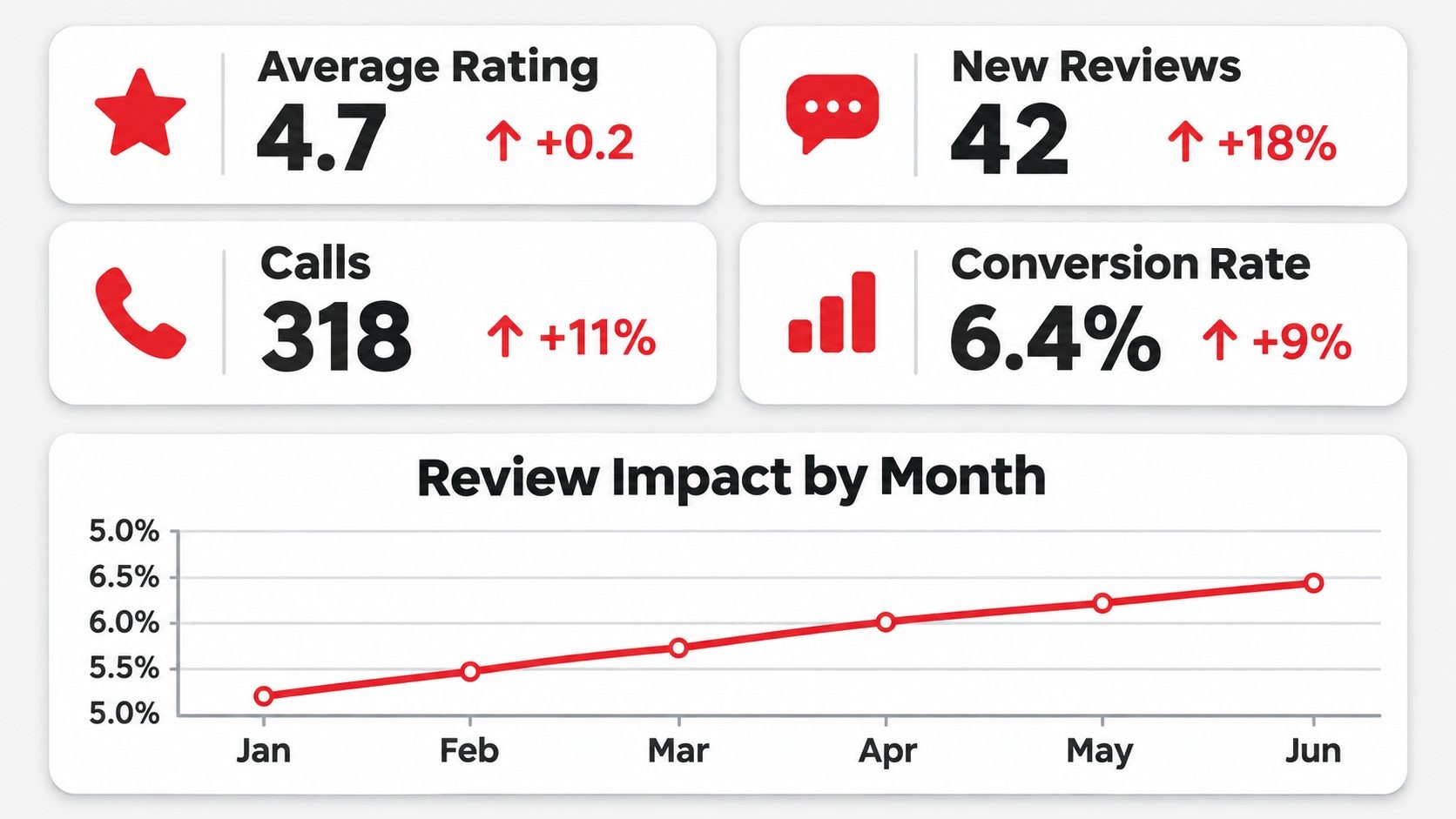
You do not need complex tools to see whether reviews are working. Track a few simple numbers each month.
- Average rating and review count on each platform.
- Review velocity, meaning how many new reviews you earn each month.
- Calls, direction requests, and website visits from your profiles.
- Conversion rate on pages that display reviews.
- Branded search volume, which can rise as your reputation grows.
Compare each month with the same period last year when possible, because seasons affect results. You can also run a free scan with SEO Site Checker on the pages where you display reviews to catch issues like slow loading, missing titles, or broken links that could weaken their impact.
FAQs
Conclusion
Online reviews are one of the clearest signals of trust a business can have. They lower the risk customers feel, influence the decisions they make, support your visibility in search, and give you honest feedback you can use to improve.
The path forward is simple and steady. Earn reviews honestly, respond to every one, show them where customers decide, and learn from what they say. Start this week by replying to your last ten reviews. That small step shows customers you are listening, and it begins the habit that turns reviews into lasting growth.
No Tags

Comments (0)