
If you run a small business, you have probably asked yourself this question more than once: should I spend my limited marketing budget on SEO or on pay-per-click ads? Both put your business in front of people who are searching on Google. Yet they work in very different ways, they cost money in very different ways, and they pay off on very different timelines.
This guide explains SEO vs PPC in plain language, compares costs and results, shows how each one fits different kinds of small businesses, and gives you a simple framework for choosing. If you are still building your overall plan, start with our guide to digital marketing for small business, then come back here to pick your search strategy.
Quick Answer: SEO or PPC?
SEO builds lasting traffic over time and costs less per visitor in the long run, while PPC brings fast traffic that stops the moment you stop paying. Most small businesses do best by starting with the one that fits their cash flow and timeline, then adding the other.
Key takeaways
- Speed: PPC can bring visitors within days. SEO usually takes months to build momentum.
- Cost: SEO needs steady time and effort. PPC charges you for every click.
- Longevity: SEO results keep working after you stop. PPC results end when the budget ends.
- Best starting point: Choose PPC if you need leads now and can afford the clicks. Choose SEO if you can wait and want a lasting asset. Use both when you can.
SEO vs PPC at a Glance
Before the details, here is a side-by-side view. Use it as a quick reference as you read.
| Factor | SEO | PPC |
|---|---|---|
| Cost model | Pay for time, content, and expertise | Pay per click, plus management |
| Speed to results | Slow, often several months | Fast, often days |
| Traffic longevity | Keeps working over time | Stops when the budget stops |
| Trust | Often seen as more credible | Labeled as ads, so some people skip them |
| Control | Limited control over rankings | Strong control over targeting and budget |
| Scalability | Grows gradually | Scales quickly with more budget |
| Best for | Long-term growth and lower cost per lead | Launches, promotions, and quick leads |
No row declares a winner on its own. SEO wins on longevity and cost over time, PPC wins on speed and control, and the right choice depends on your situation, which the rest of this guide helps you assess.
What Is SEO?
SEO, or search engine optimization, is the practice of improving your website so it appears higher in unpaid search results. When someone searches for what you sell, SEO helps your pages show up in the main results without you paying for each click.
How SEO Works in Plain Language
Search engines want to show people the most helpful, trustworthy result for each search. SEO is the work of proving that your page is that result. You do this by publishing useful content, making your site easy to use and easy for search engines to read, and earning mentions and links from other trusted websites. Think of it as building a good reputation online, one page and one link at a time.
The Four Parts of SEO
Most SEO work falls into four areas:
- On-page SEO: the words, titles, headings, and images on your pages. Our guide to on-page SEO techniques that actually work covers this in depth.
- Technical SEO: site speed, mobile friendliness, secure connections, and clean site structure.
- Content: helpful articles, service pages, and guides that answer real customer questions.
- Off-page SEO: links and mentions from other websites, plus reviews and business listings.
Google also explains the fundamentals in Google's SEO Starter Guide, which is a good free reference for beginners.
A realistic expectation helps here. In the first month, most SEO work is invisible. You are fixing problems, improving pages, and publishing content that search engines still need to find, understand, and trust. Visible gains usually appear gradually, first as more impressions in Google Search Console, then as higher positions, and finally as more clicks and leads. Knowing this pattern keeps you from quitting too early.
Pros of SEO
- Lasting results. A page that ranks well can bring visitors for months or years without a per-click fee.
- Lower cost per visitor over time. The early effort is real, but each new visitor costs less as your rankings grow.
- Builds trust. Many people trust organic results more than ads, so ranking well adds credibility.
- Compounds over time. Every good page, link, and review adds to the strength of your whole site.
Cons of SEO
- It is slow. New websites in particular can wait several months before seeing meaningful traffic.
- Results are not guaranteed. Search engines change their systems, and competitors keep improving.
- It needs ongoing work. Content gets old, and rankings slip when you stop updating.
- It takes skill. Without experience, it is easy to spend months on things that do not matter.
What Is PPC?
PPC, or pay-per-click advertising, means you pay to place ads in search results or on other platforms, and you are charged each time someone clicks. The most common form for small businesses is search advertising, where your ad appears above or below the organic results when someone types a related search.
How Pay-Per-Click and the Ad Auction Work
On Google, every search triggers a tiny auction. You choose keywords, write an ad, set a maximum bid, and point the ad to a page on your site. Google then decides which ads to show and in what order, and your bid is only one part of that decision. The quality of your ad and landing page matters too. You can read the details in Google's explanation of how the Google Ads auction works. The takeaway for a small business is encouraging: a well-written, relevant ad can beat a bigger spender who is careless.
Main PPC Platforms for Small Businesses
- Google Ads: the biggest search advertising platform and the usual starting point.
- Microsoft Advertising: smaller volume, but often lower competition and cost.
- Meta ads (Facebook and Instagram): strong for visual products and local offers.
- Local Services Ads: a Google format for local service providers such as plumbers and cleaners, where eligible.
The right platform depends on customer intent. Search ads reach people who are actively looking for a solution, so they usually convert best for services and urgent needs. Social ads interrupt people who were not searching, which makes them better for building awareness, promoting visual products, and reaching people with an offer they did not know they wanted. Many small businesses begin with search ads only and add social ads later.
Pros of PPC
- Fast results. Ads can start bringing visitors the same week you launch.
- Precise targeting. You can focus on a location, a search term, a time of day, or a device.
- Full budget control. You set daily limits and can pause at any time.
- Easy testing. You can try different headlines and offers and see quickly what works.
Cons of PPC
- Traffic stops when spending stops. You rent your visibility instead of owning it.
- Costs can climb. Competitive keywords can become expensive, which squeezes profit margins.
- Easy to waste money. Poor targeting or weak landing pages can burn a budget without producing leads.
- Some people skip ads. Many searchers scroll straight to organic results.
Key Differences Between SEO and PPC
The two channels share a goal, which is getting you found in search. The differences lie in how they get there.
Cost Model
SEO costs are mostly time and expertise. You pay for writing, optimization, and tools, or you invest your own hours. PPC costs are direct. You pay a fee for each click, plus any management or software costs. SEO has a higher upfront effort and a lower cost per visitor later. PPC has a lower barrier to start and a cost that never shrinks on its own. It also helps to remember that SEO is not free. Even when you do the work yourself, your hours have a value, so count them when you compare the two.
Speed to Results
PPC wins on speed. A new campaign can bring visitors within days. SEO is a slower build, and it often takes months before a new page earns steady traffic. If you have an urgent deadline such as an event or a seasonal sale, PPC usually fits better.
Traffic Longevity
SEO traffic keeps coming after the work is done, as long as the page stays useful and current. PPC traffic ends the moment the budget ends. This is the clearest difference. SEO is like owning a shop. PPC is like renting a stall for each market day.
This difference changes how you should think about budgets. Money spent on SEO builds something that stays on your website, such as a service page that ranks or an article that keeps attracting readers. Money spent on PPC buys attention for the period you pay for. Neither is wasteful, but they should be judged by different standards, one by long-term growth and the other by short-term return.
Clicks and Trust
Many searchers recognize paid r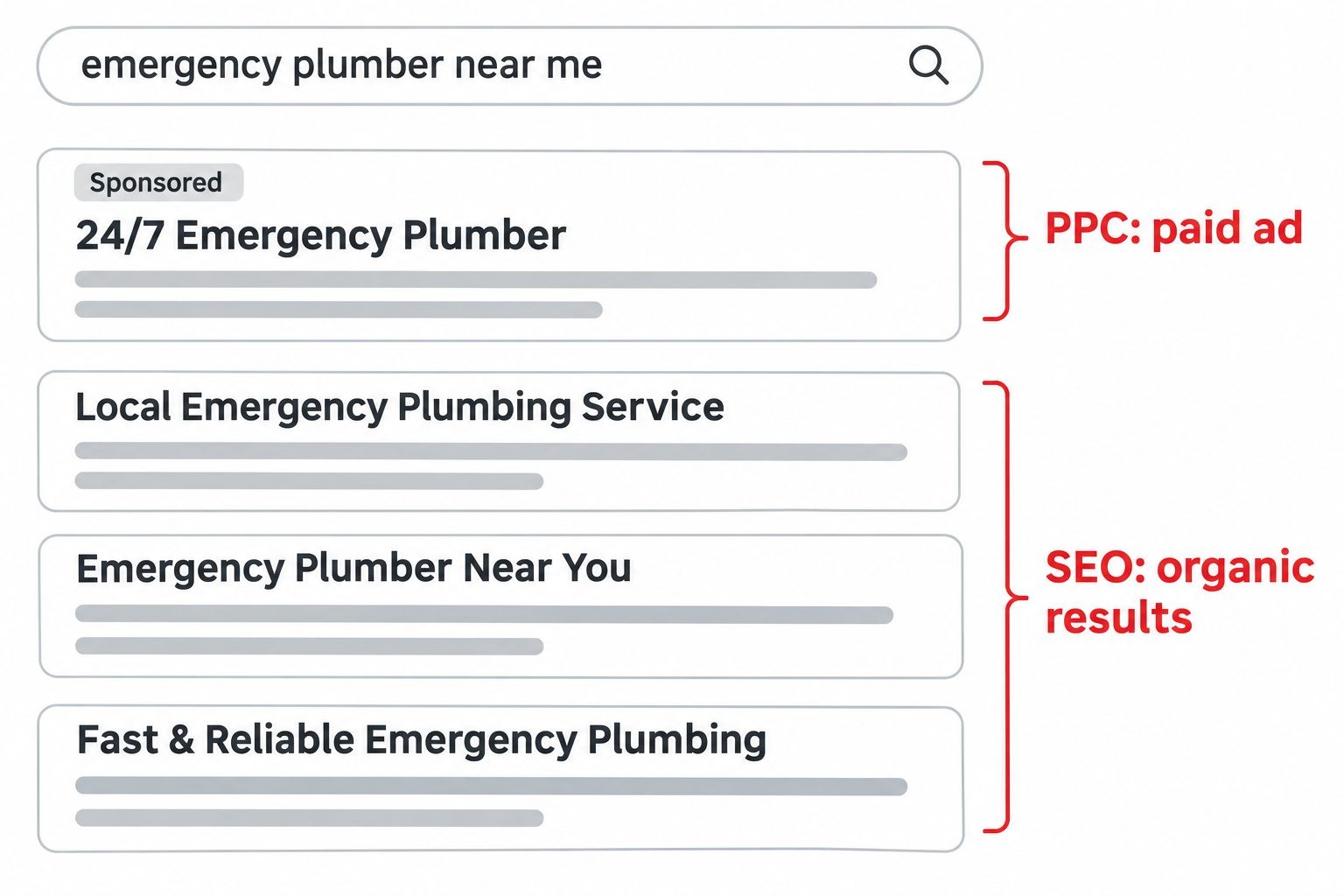 esults and prefer organic ones, especially when they are researching a big decision. Still, ads often sit at the very top of the page and capture people who are ready to act. Both have a place. Strong organic rankings add trust, and ads add visibility.
Control and Targeting
PPC gives you strong control. You choose the exact keywords, location, schedule, and message. SEO gives you influence rather than control, because you cannot force a search engine to rank your page. You can only make your page the best answer you can.
Measurement and ROI
Both can be measured, but they look different. PPC reports show clicks, costs, and conversions almost immediately, so the return is easy to calculate. SEO results take longer to measure, and you track rankings, organic traffic, and the leads those visitors produce. Set up free tools such as Google Analytics 4 and Google Search Console from day one so you have clean numbers for either channel. A short list of metrics is enough:
- Leads: calls, form submissions, bookings, and messages.
- Conversion rate: the share of visitors who become leads.
- Cost per lead: total spend divided by the number of leads.
- Cost per customer: total spend divided by customers won.
- Organic impressions and clicks: shown in Search Console, they reveal SEO progress before leads appear.
SEO vs PPC Costs: What Small Businesses Actually Pay
Prices vary a great deal by industry, location, and who does the work, so treat any single number you see online with caution. What matters more is understanding how each channel charges you.
SEO Costs: DIY, Freelancer, and Agency
You have three main ways to handle SEO. Doing it yourself costs the least money but the most time, and it works well if you enjoy learning and can stay consistent. Hiring a freelancer suits specific jobs such as writing, technical fixes, or an audit. Hiring an agency makes sense when you want a full team and have the budget for it. Whichever route you choose, expect to pay for some tools, such as a keyword research tool and an analytics setup. Always ask for a clear scope and an explanation of what will be done each month, and be wary of anyone who guarantees a number one ranking. Good questions to ask any provider include:
- What exactly will you do each month, and how will I see it?
- Which numbers will you report, and how do they connect to leads or sales?
- Who owns the website, content, and accounts if we stop working together?
- Can you show examples of similar businesses you have helped?
PPC Costs: Cost Per Click, Ad Budget, and Management
PPC has two layers. The first is the ad budget, which is the money paid to the platform for clicks. The second is management, which is the time or fee for building campaigns, testing ads, and tracking results. The price of a click depends on how many businesses want the same keyword. Searches for high-value services such as legal or insurance tend to cost far more than searches for everyday local services. Before you commit, check keyword cost estimates in the ad platform and ask whether your profit per customer can support them.
Cost Per Lead and ROI: A Worked Example
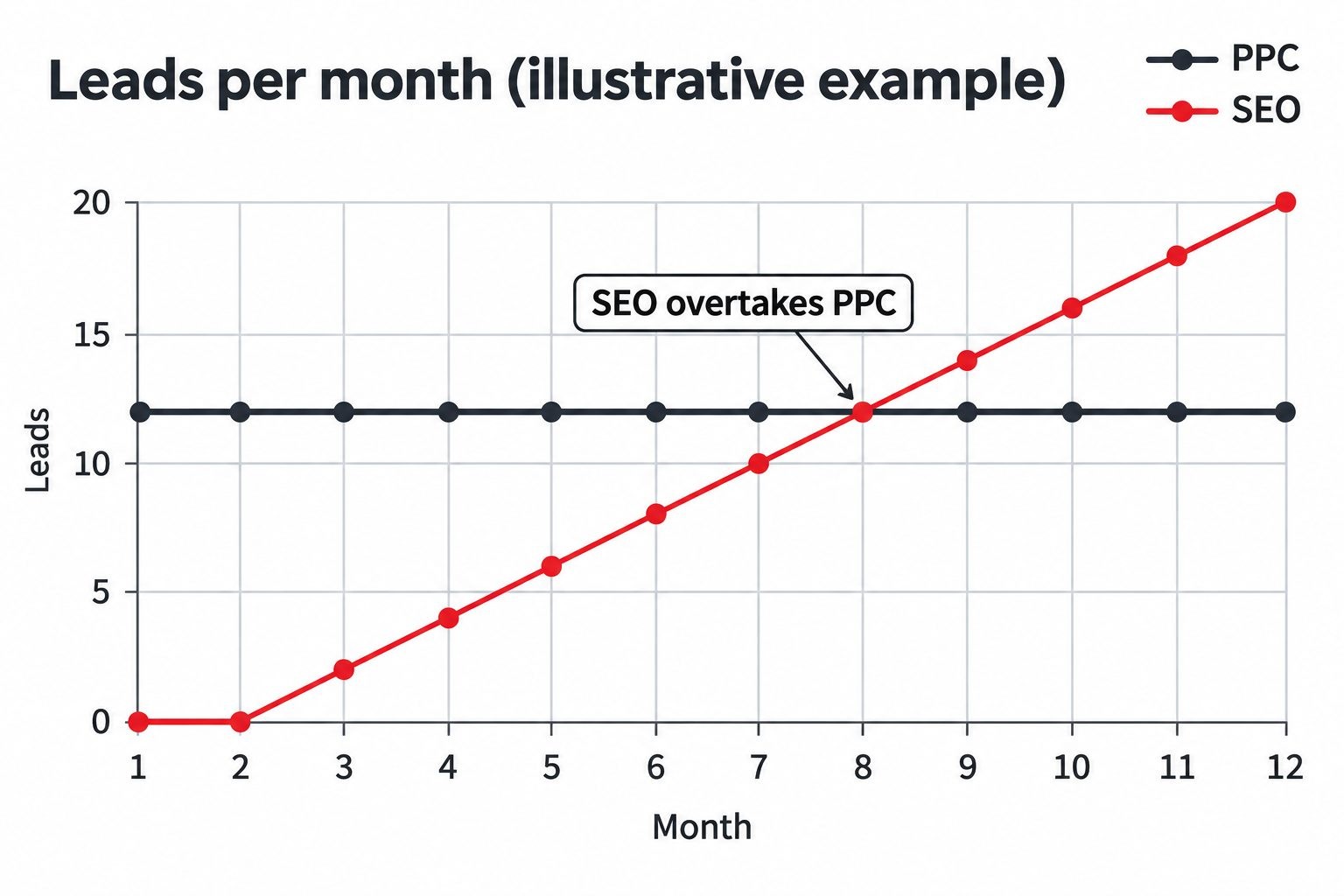
The fairest way to compare the two is cost per lead over time. Here is a simple, hypothetical example. The numbers are illustrative, so replace them with your own.
PPC: You spend 1,000 dollars per month. Clicks cost 4 dollars each, so you get about 250 clicks. If 5 percent of visitors become leads, that is about 12 leads. Your cost per lead is roughly 83 dollars. If one in four leads becomes a customer worth 500 dollars in profit, you win 3 customers and earn about 1,500 dollars in profit, which is a 50 percent return on that month's spend.
SEO: You invest 1,000 dollars per month in content, tools, and optimization. Leads start slowly and grow as rankings improve. Over twelve months they might look like this: none in the first two months, then 2, 4, 6, 8, 10, 12, 14, 16, 18, and 20 in the months after. That adds up to about 110 leads for 12,000 dollars, or roughly 109 dollars per lead across the year. By month twelve, though, you are paying around 50 dollars per lead, and the pages keep working.
The lesson is simple. PPC is cheaper in the early months, SEO becomes cheaper later, and the crossover point depends on your market. That is why many businesses use PPC to earn quickly while SEO matures.
SEO vs PPC for Different Types of Small Business
The best mix often depends on what you sell and who you sell it to.
Local Service Businesses
Plumbers, dentists, salons, and similar businesses win business from nearby searches such as "emergency plumber near me." Local SEO is especially powerful here, because a complete Google Business Profile, good reviews, and consistent listings can place you in the map results. Learn how local SEO and business listings support each other. A small PPC budget for urgent, high-value searches often works well alongside it. For example, a local heating repair company might rely on its Business Profile and reviews for everyday searches, then run ads only during the first cold weeks of winter when demand and urgency spike.
Ecommerce Stores
Online stores benefit from both. Shopping and search ads can bring buyers quickly, while SEO for category pages and product guides lowers your reliance on ad spend over time. Because margins can be thin, watch your return on ad spend closely so that paid traffic does not erase profit.
B2B and Professional Services
Buyers in B2B usually research for a long time before contacting anyone, so SEO content such as guides, comparisons, and case studies builds trust throughout that journey. PPC can capture high-intent searches, such as "accounting software for contractors," but the cost per click can be high, so target carefully.
Brand-New Businesses and Startups
A new website has no authority, which means SEO takes longer to show results. If cash allows, a small, focused PPC test can bring first customers and teach you which messages work, while you build SEO content in the background. If cash is very tight, start with free foundations such as a Google Business Profile, a helpful website, and a few well-chosen articles.
How AI Search and Zero-Click Results Change the Choice
Search is changing. Many results pages now include AI-generated summaries, maps, and ads above the classic list of links, and more searches end without a click. This affects both channels.
For SEO, it means that thin, generic content is less likely to earn visits. Clear, well-structured pages that answer questions directly, show real expertise, and carry accurate business details are more likely to be used and cited. Strong reviews and consistent listings also help search systems trust that your business is real.
For PPC, ads can sit above everything else, which keeps paid visibility valuable, but costs may rise as more advertisers compete for the same top spots. Landing page quality matters more than ever.
The practical lesson is not to abandon either channel. It is to make your content genuinely useful, keep your information accurate everywhere, and track where your customers really come from.
How to Choose: A 5-Question Decision Framework
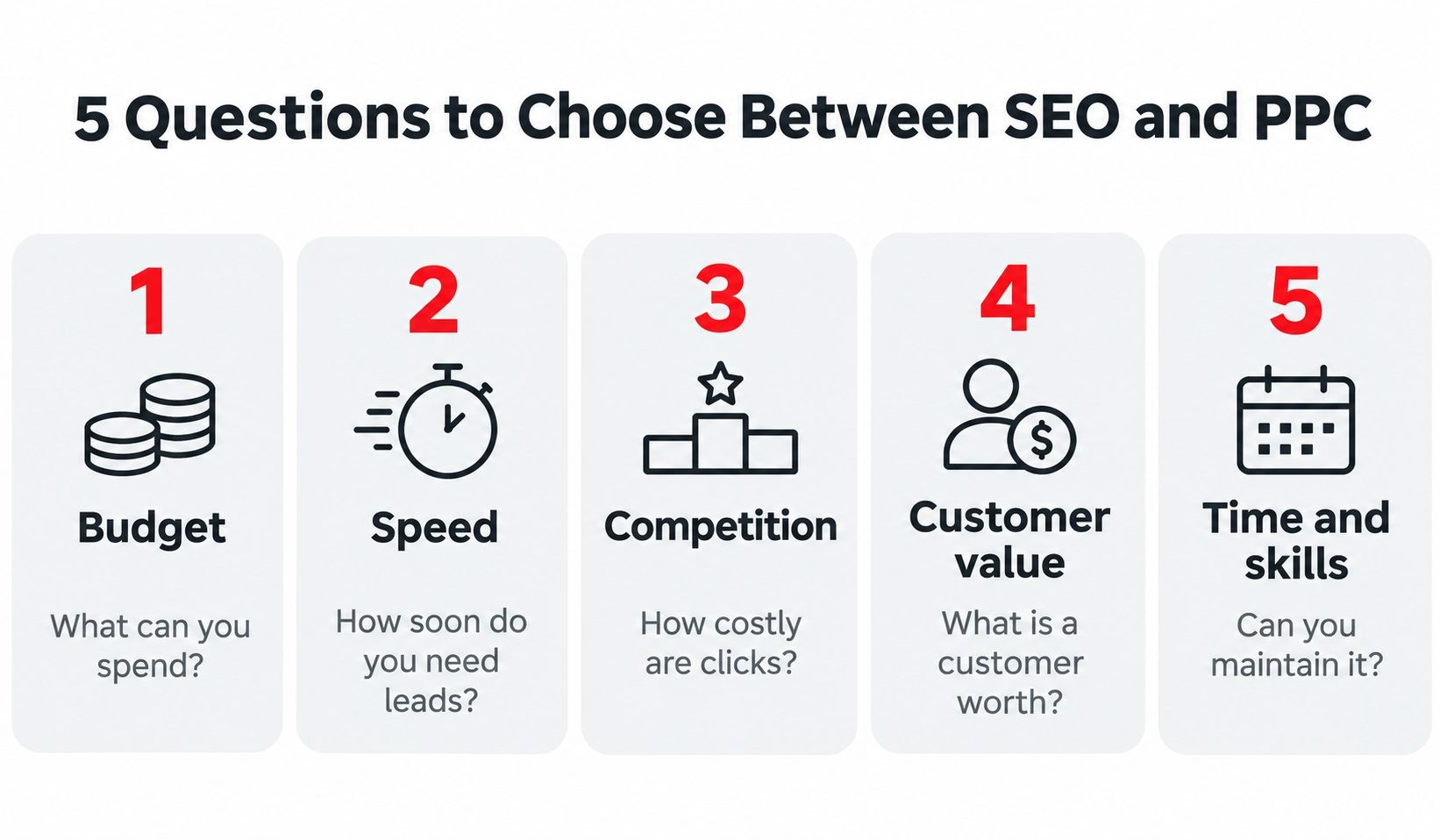
Answer these five questions honestly, and the right starting point usually becomes clear.
1. What is your budget? If you can only spend a small amount each month, SEO and free local tools usually stretch further. If you have a healthy budget and a clear offer, PPC can start producing leads sooner.
2. How fast do you need leads? If you need customers this month, PPC is the realistic option. If you can plan six months ahead, SEO is worth the wait.
3. How competitive and costly are your keywords? Search your main keywords and look at the ads and results. If the clicks look very expensive, SEO and local optimization may offer better value. If the organic results are dominated by huge brands, PPC may be easier to enter.
4. What is a customer worth to you? A high-value customer can justify expensive clicks. A low-value sale with thin margins needs cheaper traffic, which points toward SEO.
5. Do you have the time and skills? SEO needs consistent content and optimization. PPC needs careful setup and weekly monitoring. Pick the one you can actually maintain, or budget for help.
To turn your answers into a decision, give each question a quick lean. If most of your answers pointed to speed, a healthy budget, and high customer value, start with PPC. If most pointed to patience, a tight budget, and expensive clicks, start with SEO. If your answers split evenly, begin with a small version of both and let your cost per lead tell you where to invest more.
When SEO Wins, When PPC Wins, and When to Use Both
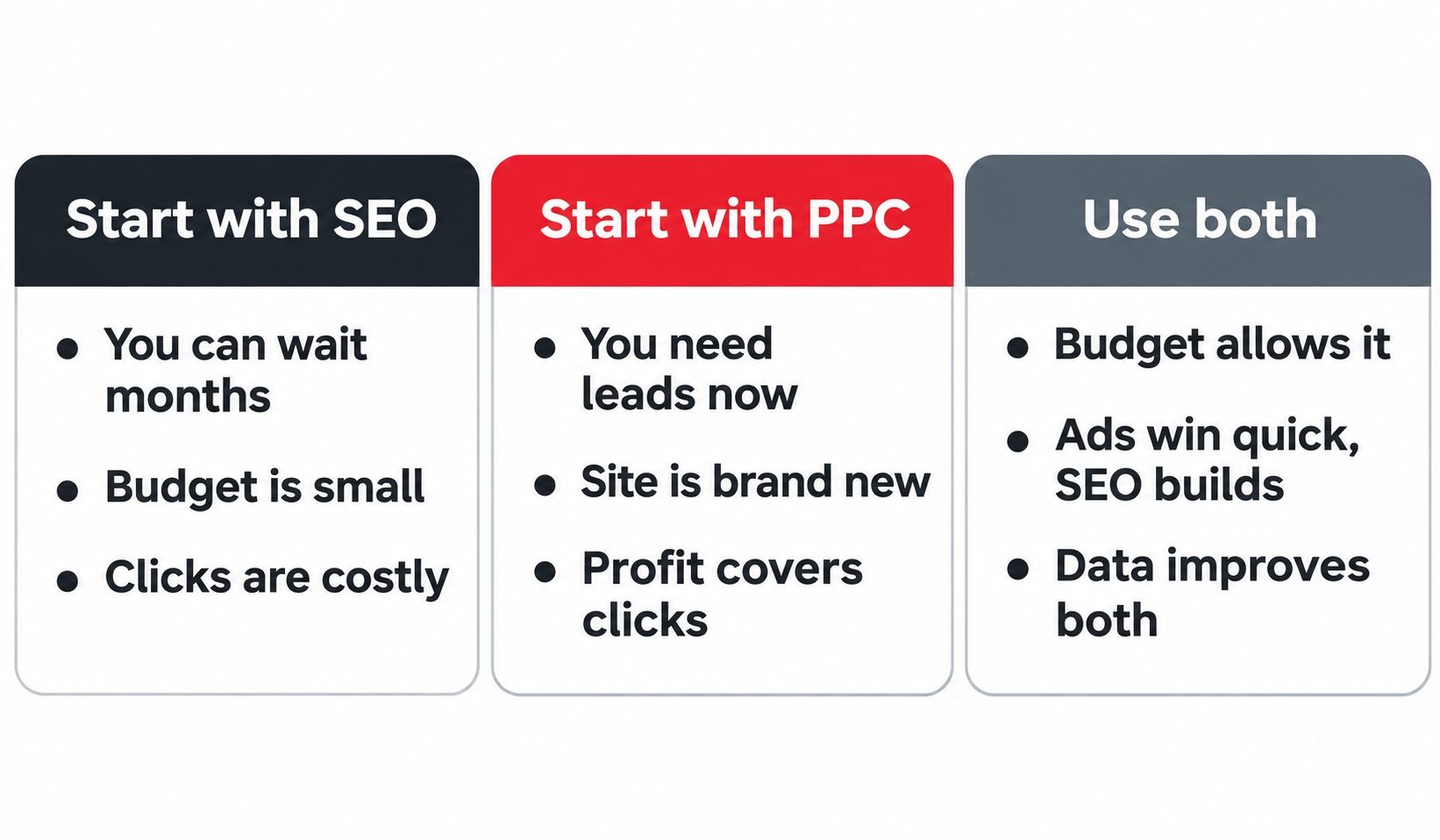
Start With SEO When
- You can wait several months for results.
- Your budget is small, and you want an asset that keeps working.
- Your customers research before buying, such as with services or considered purchases.
- Click costs in your industry are very high.
Picture a small accounting firm that serves local freelancers. Clicks for "tax accountant" can be expensive, and its clients usually research for a few weeks before calling. Publishing helpful guides, collecting reviews, and improving its local listings costs less over time and fits how its customers actually decide. That firm would likely start with SEO, then use a small ad budget during tax season.
Start With PPC When
- You need leads quickly, such as for a launch, event, or seasonal offer.
- You are testing a new product or message.
- Your site is brand new and has no authority yet.
- Your profit per customer comfortably covers the cost of clicks.
Use Both When
- You have the budget and want to dominate the results page.
- You want ads to bring quick wins while SEO builds.
- You want data from one channel to improve the other.
Sample Budget Splits by Stage
These are starting points, not rules. A brand-new business that needs customers fast might lean toward 70 percent PPC and 30 percent SEO at first, then shift as organic traffic grows. A business with steady sales might aim for 70 percent SEO and 30 percent PPC, using ads only for promotions and high-value searches. Review the split every quarter using your real cost per lead.
How to Use SEO and PPC Together
The two channels are not rivals. Used together, each one makes the other smarter.
Use PPC Keyword Data to Guide SEO Content
Ad reports show exactly which searches lead to clicks and sales. If a certain phrase converts well in your ads, build a helpful page or article around it so you can eventually win that traffic without paying for every click.
Retarget Organic Visitors
Many people visit a page and leave without acting. Retargeting ads can remind those visitors of your offer after they leave. This gives your SEO traffic a second chance to become customers.
Test Titles and Descriptions With Ads
Ads let you try different headlines quickly. When one message earns a higher click rate, reuse its wording in your page titles and meta descriptions to improve clicks from organic results too.
Own More of the Search Results Page
When your business appears in both the ad and the organic listings for the same search, you take up more space and look more established. This also protects you if a competitor bids on your brand name.
A Practical 90-Day Plan for Small Businesses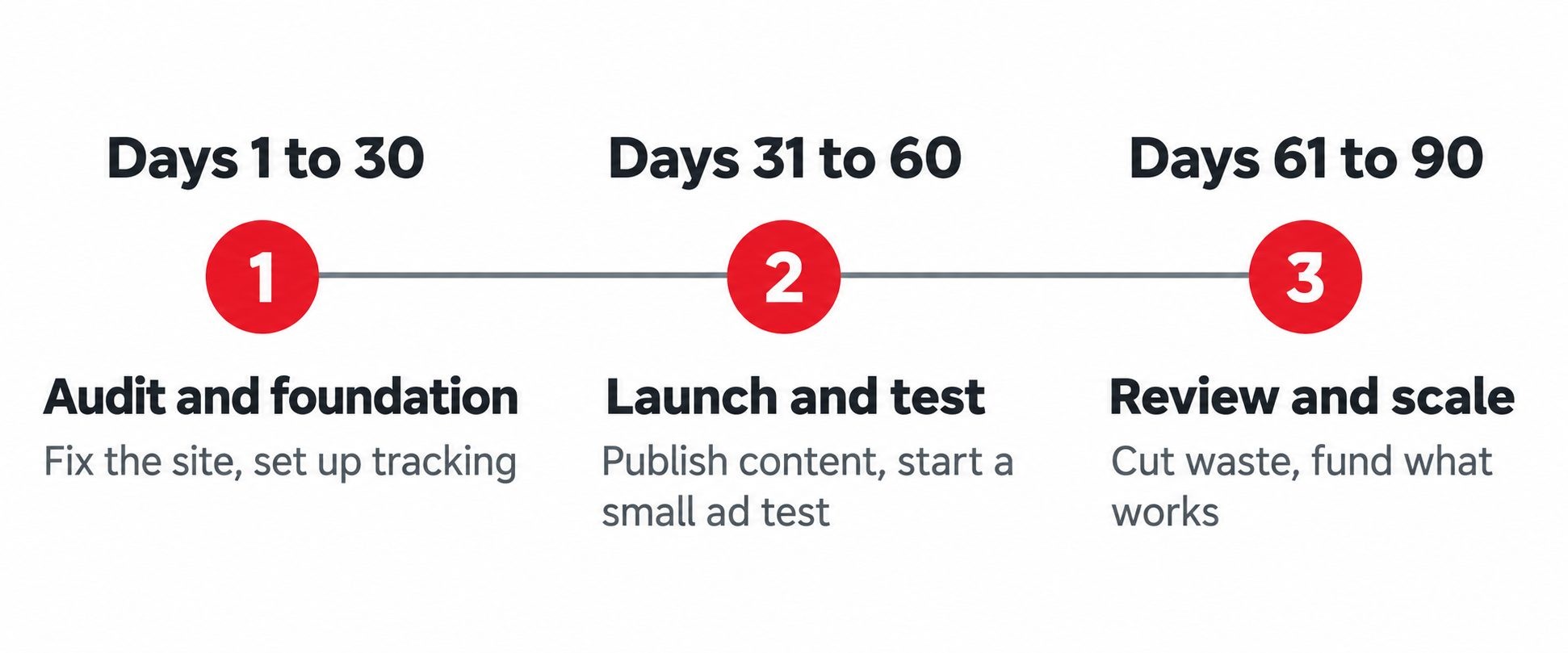
If you are ready to act, here is a simple way to start without overspending.
Days 1 to 30: Audit and Foundation
Begin with the basics, because both channels depend on them. Make sure your website loads quickly, works on phones, and clearly explains what you offer and how to contact you. Run a free site audit with a tool such as SEO Site Checker to spot broken pages, missing titles, and speed problems. Claim and complete your Google Business Profile, and install Google Analytics 4, Google Search Console, and conversion tracking. Finally, work through the on-page basics in our guide to on-page SEO techniques that actually work.
Days 31 to 60: Launch SEO Content and a Small PPC Test
Pick a handful of keywords that match what customers actually search, using a keyword research tool or the suggestions Google shows as you type. Write or improve one page for each main service, and publish your first helpful article. At the same time, launch a small PPC test with a strict daily limit, a narrow location, and a few tightly related keywords. Send clicks to a page built for that offer, not to your homepage.
Days 61 to 90: Review, Cut Waste, and Scale
Look at the numbers. In your ads, pause keywords that spent money without producing leads and add negative keywords to block irrelevant searches. In SEO, check Search Console for pages that are getting impressions but few clicks, and improve their titles and descriptions. Compare your cost per lead for each channel, then move more budget toward whichever is performing better. Repeat the review every month.
By the end of 90 days you will not have perfect results, but you should have three valuable things: a clean, tracked website, real data on what your customers search and click, and a clear sense of your cost per lead from each channel. That information is more valuable than any guess, and it lets you decide with confidence where the next dollar should go.
Common SEO and PPC Mistakes to Avoid
Most wasted money in search marketing comes from the same handful of errors.
- Judging SEO too soon. Expecting big results in four weeks leads many owners to quit right before the payoff.
- Using broad keywords in PPC. Loose matching can attract irrelevant clicks that drain a small budget. Review the search terms report weekly.
- Skipping conversion tracking. Without it, you cannot tell which clicks became customers.
- Sending ad traffic to the homepage. A focused landing page with a single clear action converts far better.
- Chasing too many keywords. Spreading effort across dozens of topics leaves every page weak. Focus on a few that match real buying intent.
- Never refreshing old content. Pages that once ranked can slip when information gets outdated, so update them at least once a year.
- Ignoring Quality Score and relevance. Google rates how relevant your ads and pages are, which affects what you pay. Read more about Quality Score before you scale spending.
- Neglecting basic SEO health. Slow pages, thin content, and missing titles quietly hold rankings back. Our list of common SEO mistakes that cost traffic shows what to fix first.
Tools for SEO and PPC
You do not need an expensive stack. Choose one tool for each job and learn it well.
- Site audits and on-page checks: SEO Site Checker for quick technical and on-page reviews.
- Analytics: Google Analytics 4 and Google Search Console, both free.
- Keyword research: Google Keyword Planner, plus paid tools such as Semrush or Ahrefs if you need more depth.
- Ad management: Google Ads and Microsoft Advertising, with their built-in reports.
- Rank and traffic tracking: a simple rank tracker or the performance report in Search Console.
Check current pricing before you commit, because plans and free tiers change often.
Frequently Asked Questions
Conclusion: Start With the Channel That Fits, Then Add the Other
SEO vs PPC is not a battle with one winner. SEO gives you a lasting asset that grows more valuable and cheaper per lead with time, and PPC gives you speed, control, and quick feedback. The smartest small businesses match the channel to their cash flow and timeline, track cost per lead honestly, and add the second channel when they can.
Take one step this week. Run a site audit, claim your Google Business Profile, or set a small, tracked PPC test. Then review your numbers in 30 days and keep improving.
Remember that the goal is not to win an argument about channels. It is to bring in customers at a cost your business can sustain. Let your own data, not general opinions, tell you where to invest next.
No Tags

Comments (0)